

Gryphon Editions Outlet
4 vol Hayek collection
4 vol Hayek collection
Couldn't load pickup availability
CONDITION: The books are NEW and in shrink wrap, just have a few minor flaws, such as some fading and scratches to the gilded page edges.
This collection includes Hayek's The Constitution of Liberty, The Fatal Conceit, The Trend of Economic Thinking, and The Sensory Order.
The Austrian-born economist had first become interested in his field while serving as an artillery officer in World War I, and the year 1918 found him at the University of Vienna where he received degrees in law and economics. He began teaching at the London School of Economics in 1932 and later taught at Stanford University and the University of Chicago, among other institutions. Along the way, he helped organize the young scholars who became known as the Vienna Circle, was president of the London Economics Club (1936), and founded (1947) and was president of the Mont Pelerin Society. In 1974, he was awarded the Nobel Prize in Economics, and the year before he died the United States gave him the Medal of Freedom. This last honor was deeply fitting, freedom having been central to Hayek’s thinking throughout his long career.
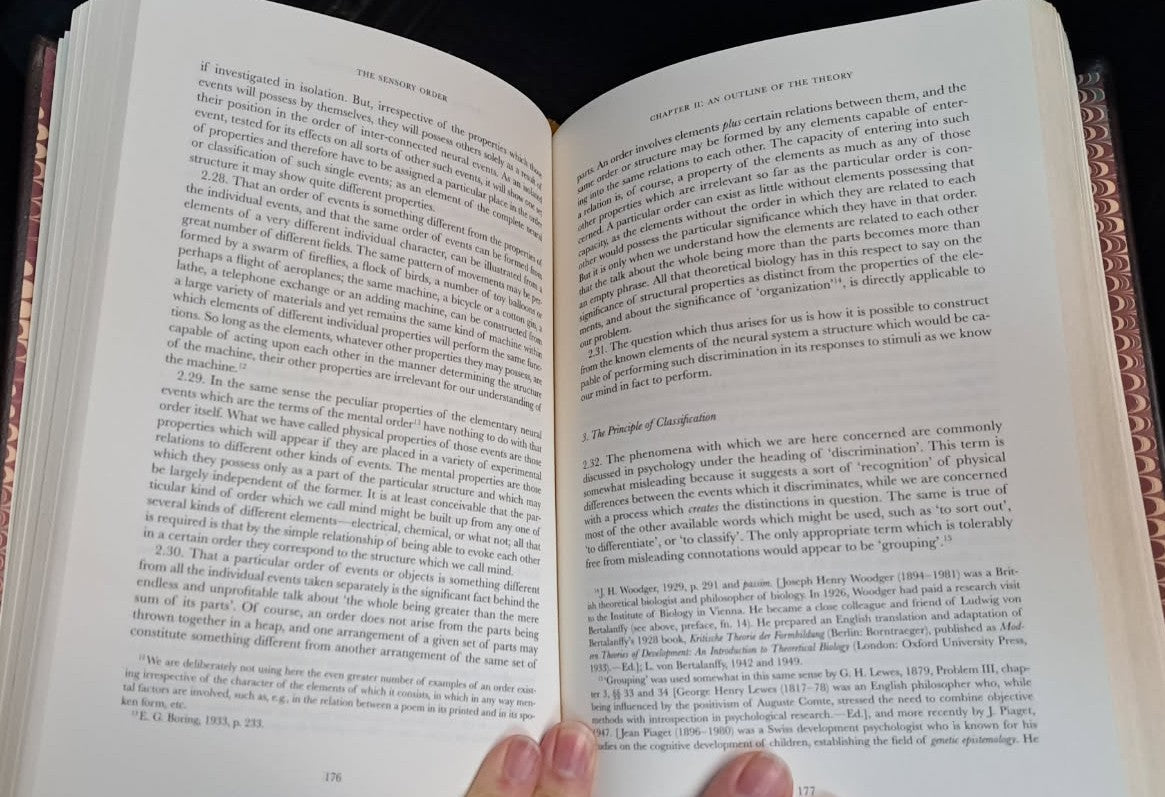
:The Sensory Order" description: Hayek was one of the leading voices in economic and social theory; however, he also wrote on theoretical psychology. “The Sensory Order”, first published in 1952, sets forth his classic theory of mind in which he describes the mental mechanism that classifies perceptions that cannot be accounted for by physical laws. Although “The Sensory Order” was not widely engaged with by either psychologists or social scientists at the time of publication, it is seen today as essential for fully understanding Hayek’s more well-known work. This edition pairs the original 1952 book with additional essays related to The Sensory Order’s key themes, including a student paper from 1920 in which Hayek outlined the basic ideas he fully developed in the 1952 book.
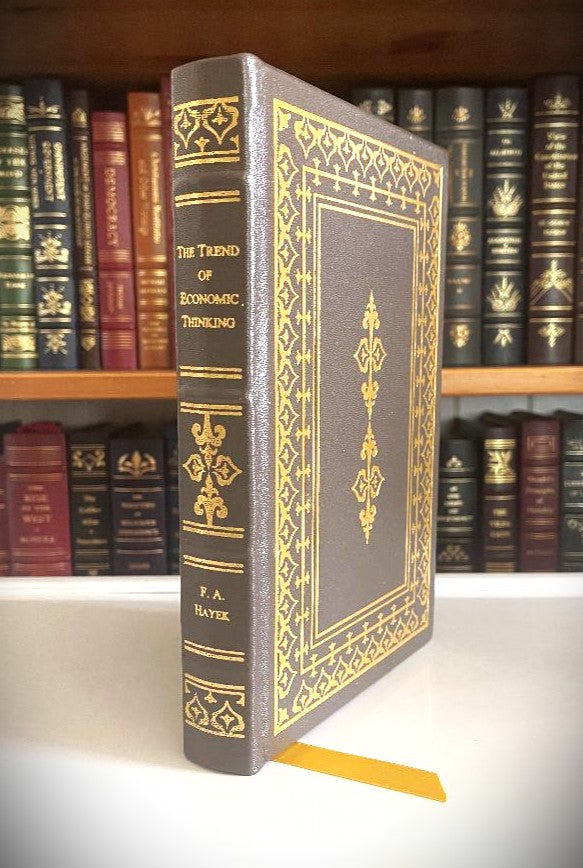
“The Trend of Economic Thinking” description: captures Hayek’s views on political economists and economic history—on Mandeville, Hume, Cantillon, Adam Smith, and Henry Thornton. Framed by insightful editorial notes, the book provides a fascinating introduction to the historical context of political economy and the evolution of monetary practices. In a highlight of the collection, “On Being an Economist,” Hayek reflects on the influence of economists, the time required for new ideas to take hold, the best way to educate economic theorists, and the need to follow one’s own interests, often in opposition to fashionable beliefs. As always, the words of this outspoken scholar are sure to provoke debate.
"The Constitution of Liberty" description: This book is considered Hayek’s classic statement on the ideals of freedom and liberty, ideals that he believes have guided—and must continue to guide—the growth of Western civilization. Here Hayek defends the principles of a free society, casting a skeptical eye on the growth of the welfare state and examining the challenges to freedom posed by an ever expanding government—as well as its corrosive effect on the creation, preservation, and utilization of knowledge. In opposition to those who call for the state to play a greater role in society, Hayek puts forward a nuanced argument for prudence. Guided by this quality, he elegantly demonstrates that a free market system in a democratic polity—under the rule of law and with strong constitutional protections of individual rights—represents the best chance for the continuing existence of liberty.
"The Fatal Conceit: The Errors of Socialism" description: Hayek gives the main arguments for the free-market case and presents his manifesto on the “errors of socialism.” Hayek argues that socialism has, from its origins, been mistaken on factual, and even on logical, grounds and that its repeated failures in the many different practical applications of socialist ideas that this century has witnessed were the direct outcome of these errors. He labels as the “fatal conceit” the idea that “man is able to shape the world around him according to his wishes.”
Share